How the implemented ANC algorithms compare in this repository.
The benchmark suite combines synthetic broadband plants, periodic disturbances, parameter sweeps, and one external trace path. The goal is not to mimic a specific acoustic rig exactly; it is to compare the controllers under reproducible conditions with enough structure to expose their tradeoffs.
Primary Benchmark Summary
| Algorithm | Typical scenario | Residual RMS | Attenuation (dB) | Convergence (samples) | Takeaway |
|---|---|---|---|---|---|
| FXLMS | Broadband feedforward | 0.000500 | 61.127 | 256 | Strong attenuation and fast convergence with a good secondary-path estimate. |
| Leaky FXLMS | Broadband with coefficient regularization | 0.086128 | 16.408 | 287 | Safer under drift or output-power concerns, but gives up steady-state performance. |
| FBFXLMS | Broadband with reference contamination | 0.086128 | 16.408 | 287 | Useful when acoustic feedback corrupts the reference microphone. |
| FU-RLMS | Bursty broadband with recursive control law | 0.227638 | 2.992 | -1 | Capable in principle, but much harder to tune and easier to destabilize. |
| Waveform synthesis (LMS) | Synchronized periodic source | 0.089001 | 15.425 | 2591 | Good fit for periodic disturbances, poor fit for broadband content. |
| Adaptive notch | Single dominant tone | 0.080201 | 17.034 | 256 | Strong narrowband option when one rotating-order component dominates. |
| Multi-tone | Stable harmonic bank | 0.000000 | 269.136 | 256 | Best-case narrowband match; exceptional only when the disturbance truly matches the tone bank. |
| Feedback ANC | Periodic source without a reference mic | 0.147765 | 9.863 | 338 | Practical only when the disturbance is predictable enough to reconstruct a usable reference. |
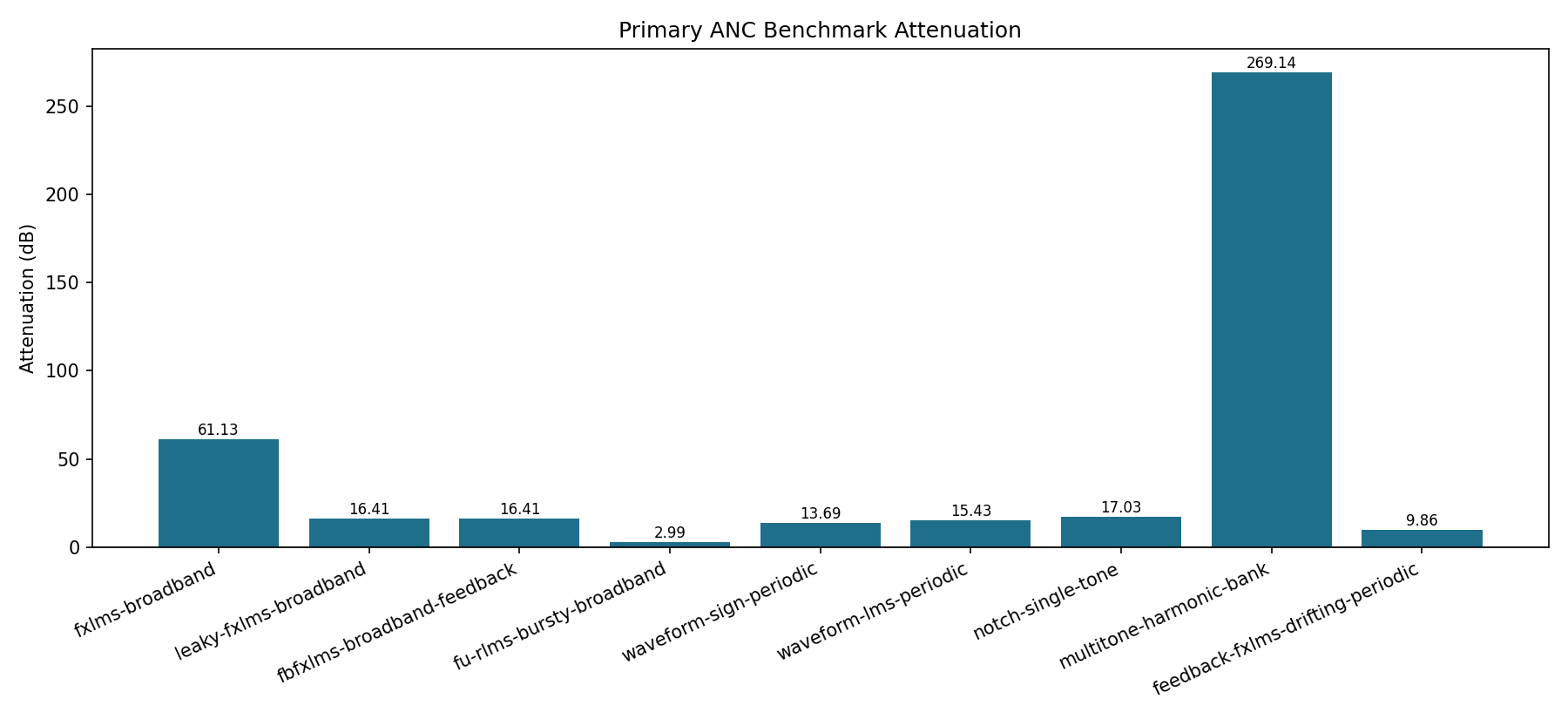
Primary attenuation
The primary benchmark reinforces the split between broadband feedforward methods and synchronized narrowband methods.
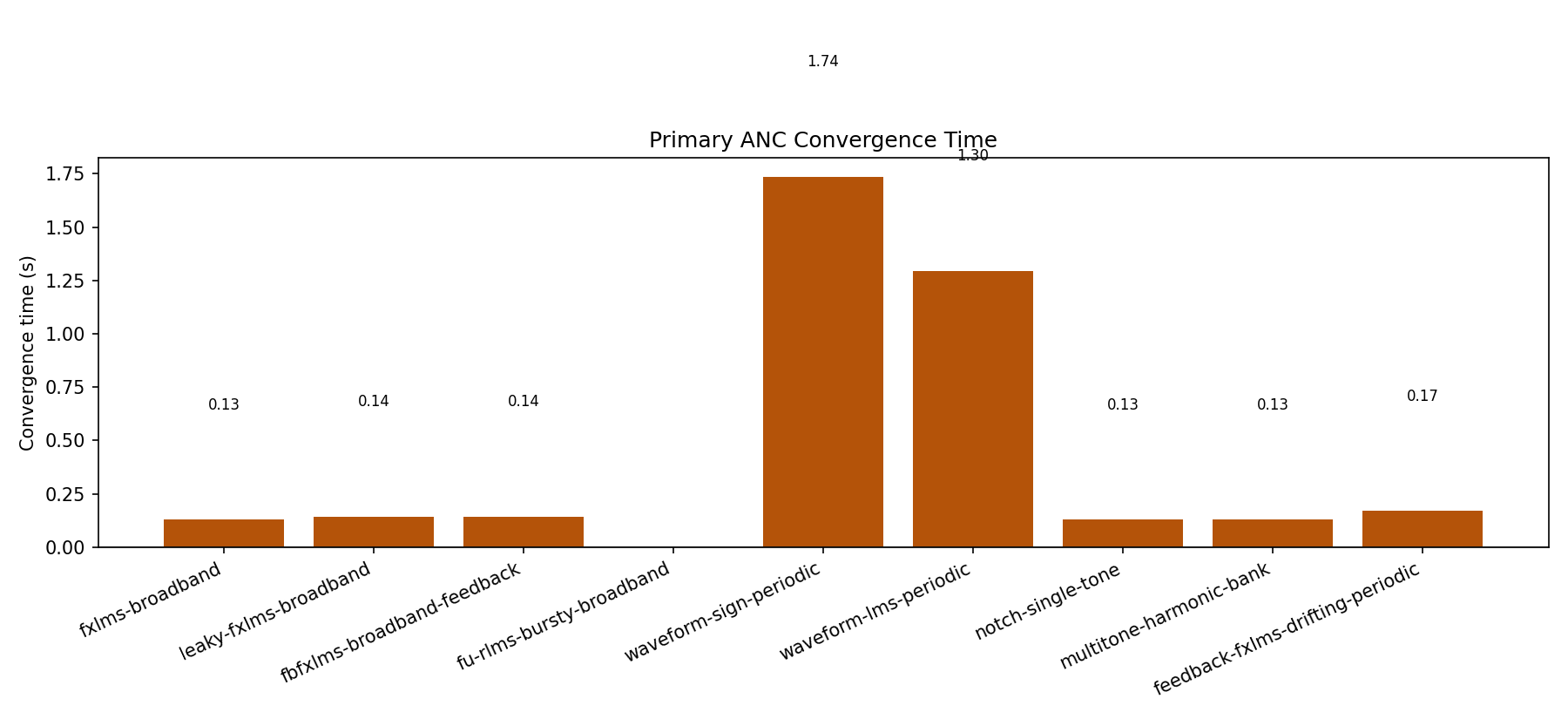
Convergence speed
The convergence metric is the first sample where the trailing residual RMS falls below half of the baseline disturbance RMS.
Match The Controller To The Disturbance
Broadband versus narrowband
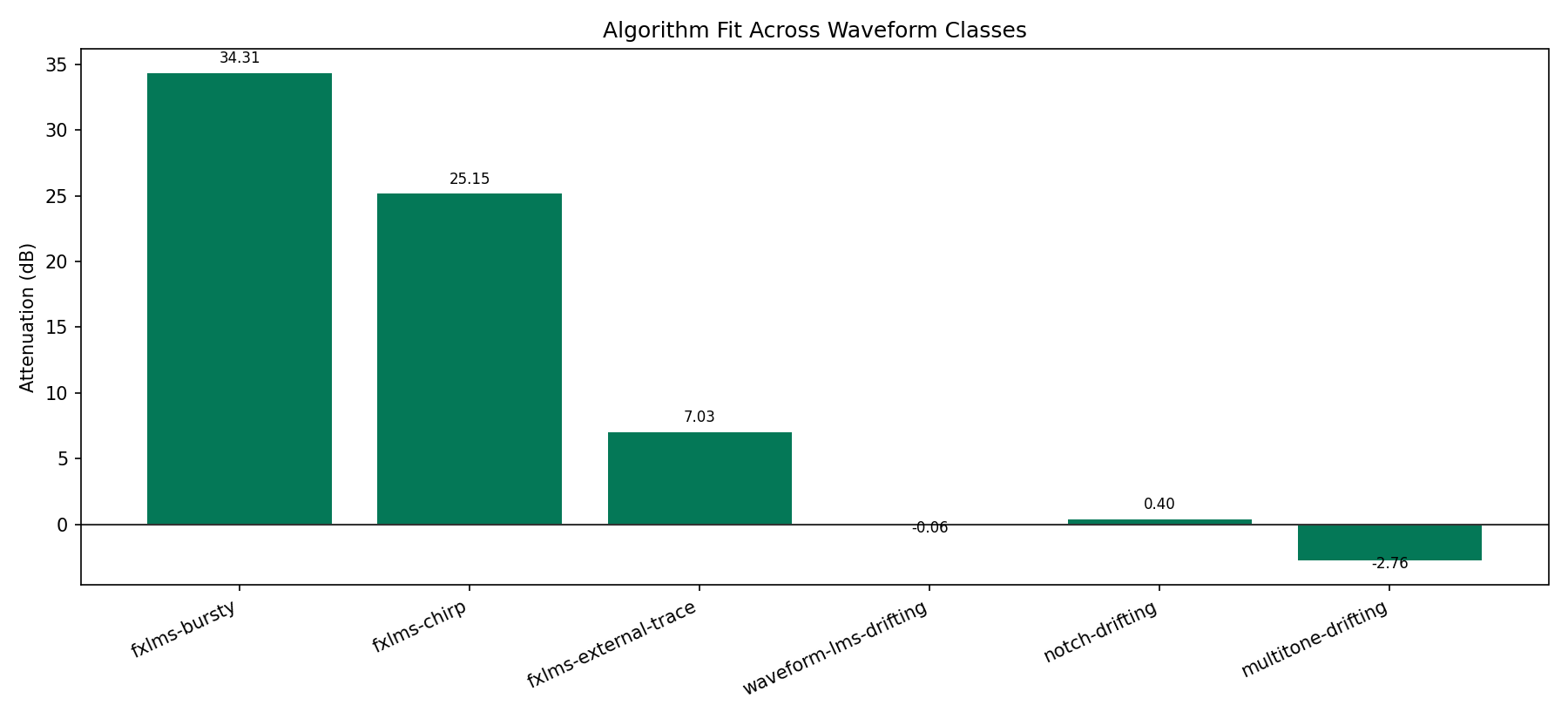
Controller choice follows disturbance structure more than raw headline dB. Feedforward FXLMS-family methods handle bursty or chirped broadband inputs well, while waveform synthesis, adaptive notch, and multi-tone controllers win when the source is periodic and synchronized.
Algorithm fit by waveform class
This matrix matters more than the single headline table because it shows where each algorithm is naturally matched or mismatched.
What The Sweep Data Shows
FXLMS
Step size is the main speed-versus-stability knob. The sweep improves steadily until it breaks hard at an unstable setting.
Leaky FXLMS
Leakage trades off attenuation for robustness. The closer the factor stays to 1.0, the less steady-state attenuation you sacrifice.
FBFXLMS
The feedback-path estimate matters more than the absolute feedback strength. A strong but correctly modeled feedback path is still manageable.
Waveform synthesis (LMS)
Periodic waveform synthesis improves with larger step sizes until it reaches a practical limit, but it remains tied to synchronized narrowband content.
Practical Selection Guide
| Use case | Recommended starting point | Why |
|---|---|---|
| Broadband ANC with a good reference microphone | FXLMS | Best overall combination of stability, speed, and attenuation in the benchmark suite. |
| Broadband ANC with drift or output-power concerns | Leaky FXLMS | The leakage term acts like a regularizer and reduces long-run coefficient growth. |
| Reference microphone contaminated by actuator feedback | FBFXLMS | Reconstructs a feedback-free reference before running the FXLMS update. |
| Single stable tone | Adaptive notch | Focuses adaptation on one sinusoidal component and its quadrature pair. |
| Several stable harmonics | Multi-tone | Runs a bank of parallel notch-style sections and is nearly ideal when the tone bank matches the disturbance. |
| Periodic source with synchronizing pulse | Waveform synthesis | Stores one canceling period directly, which is simple and effective for periodic noise. |
| No reference microphone available | Feedback ANC | Reconstructs a reference from the measured error plus the secondary-path model. |
| Recursive controller required | FU-RLMS | Only choose it when an IIR control law is worth the tuning cost. |
Interpreting The Numbers
The absolute attenuation values differ from the original paper because this repository uses floating-point simulation and synthetic acoustic-style FIR paths rather than the fixed-point hardware and duct setup described in the source report. The relative behavior remains aligned with the paper: FXLMS-family methods are strong broadband defaults, feedback-aware variants help when the reference is contaminated, and narrowband methods such as adaptive notch, multi-tone, and waveform synthesis are most effective when the disturbance is genuinely periodic.